
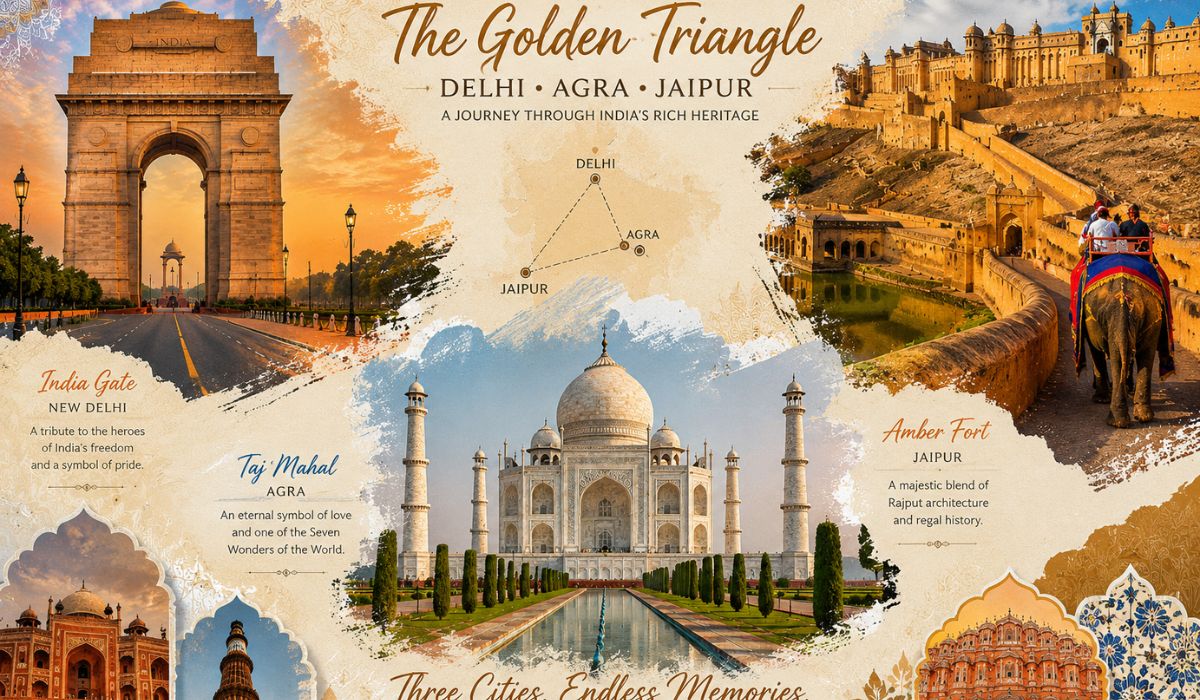
If you’re planning your first trip to India and feel overwhelmed by where to start, you’re not alone. India is enormous, culturally layered, and logistically challenging for first-time visitors. That’s exactly why the Golden Triangle Tour has become the go-to starting point for travelers from the USA, UK, Canada, Australia, and Europe.
This single circuit gives you a concentrated dose of India’s most iconic experiences: Mughal monuments, Rajput palaces, bustling bazaars, street food, and centuries of history — all within a manageable route that doesn’t require crossing the entire subcontinent.
This guide is written for people who’ve never been to India before. It answers everything you actually need to know before booking — what the tour covers, how long it takes, what it costs, whether it’s safe, and how to make the most of your time in Delhi, Agra, and Jaipur.
Slots fill up fast in peak season — secure your verified guide or tour today, one message away on WhatsApp.
💬 Chat on WhatsAppWhat is the Golden Triangle Tour in India?
The Golden Triangle Tour is a travel circuit connecting three of India’s most historically significant cities:
- Delhi — India’s sprawling capital, with layers of Mughal, British, and modern history
- Agra — Home of the Taj Mahal and the Agra Fort, both UNESCO World Heritage Sites
- Jaipur — The Pink City of Rajasthan, known for its palaces, forts, and vibrant bazaars
When these three cities are plotted on a map, they form a rough triangle shape in northern India — hence the name. The total driving distance around the circuit is approximately 720 km, making it compact enough to complete in under a week while still covering an extraordinary range of experiences.
What makes this tour stand out is how efficiently it showcases India’s most recognizable landmarks. You can see the Taj Mahal, walk through Mughal-era forts, explore a Rajput hill fort, and experience two of India’s most dynamic urban environments — all on a single connected route.
For first-time visitors especially, the Golden Triangle provides structure without feeling rushed. You don’t need to navigate complex train connections across multiple states or take overnight flights between distant regions. Everything is within a few hours of each other by road or rail.
Why is it Called the Golden Triangle?
The term “Golden Triangle” comes from the triangular shape the three cities form on a map, with Delhi in the north, Agra to the southeast, and Jaipur to the southwest.
The word “golden” reflects both the richness of the cultural and historical heritage along this route and the enormous tourism value it generates for India. Together, these three cities receive tens of millions of domestic and international visitors every year. The Taj Mahal alone draws over six million visitors annually.
The circuit has been recognized internationally as one of the world’s great travel routes — not because it’s the easiest or the most comfortable (India never promises that), but because no comparable stretch of road delivers so much historical, architectural, and cultural depth in such a short distance.
Golden Triangle Route Map and Distances
Understanding the geography helps you plan realistic travel days and avoid the common mistake of underestimating travel times.
| Route | Distance | Travel Time (by Road) | Travel Time (by Train) |
|---|---|---|---|
| Delhi to Agra | ~200 km | 3–4 hours | 1.5–2.5 hours (Gatimaan/Shatabdi) |
| Agra to Jaipur | ~240 km | 4–5 hours | 4–5 hours |
| Jaipur to Delhi | ~280 km | 5–6 hours | 4–5 hours |
*Travel (by Train) needs extra time for transfers to and from the railway station and hotel
Transportation options:
- Private car with driver — The most flexible and popular option for international tourists. You control your stops, schedule, and pace.
- Train — Cost-effective and an experience in itself. The Gatimaan Express between Delhi and Agra is excellent. Book well in advance on IRCTC.
- Flight — Delhi and Jaipur have airports with frequent connections, but Agra’s airport has limited commercial service. Flying between cities reduces travel time but increases cost and limits flexibility.
- Guided tour packages — Handle all logistics, accommodation, and transport. Ideal for first-timers who don’t want to manage bookings across multiple cities. See Golden Triangle Tour Packages for curated options.
History Behind the Golden Triangle Circuit
Each city on the route carries a distinct historical identity, and understanding that context makes the visits far more meaningful.
Delhi has been the seat of power for multiple empires. The city you see today is actually the seventh or eighth iteration built on this land — from ancient kingdoms to the Delhi Sultanate, the Mughals, and finally the British colonial administration. Old Delhi (Shahjahanabad) was built by the Mughal emperor Shah Jahan in the 17th century. New Delhi was designed by British architects Edwin Lutyens and Herbert Baker and inaugurated in 1931.
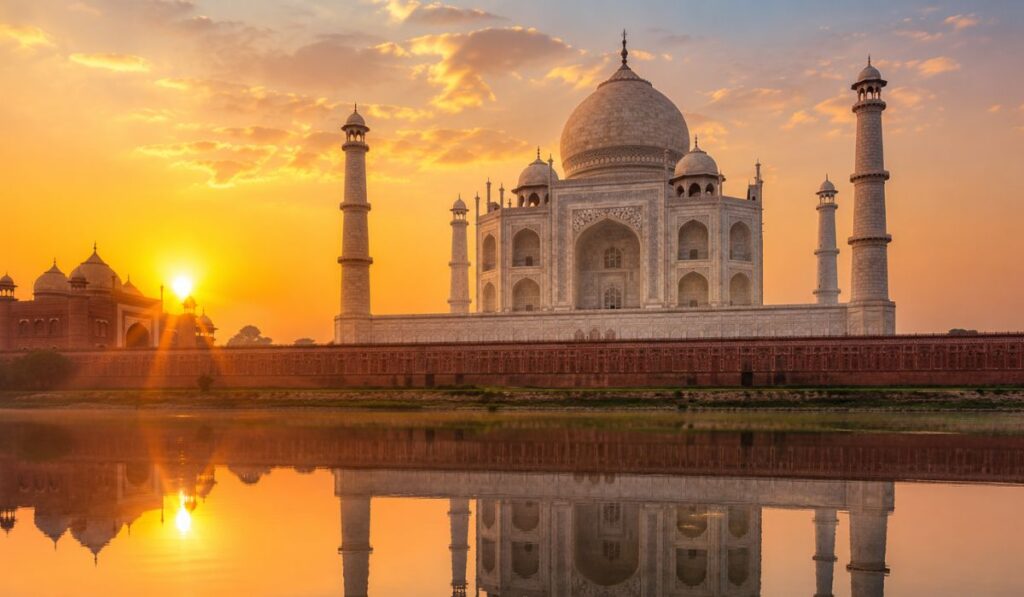
Agra rose to prominence as the capital of the Mughal Empire under Emperor Akbar in the 16th century. It was here that the Mughals built their greatest architectural achievements, including the Agra Fort and the Taj Mahal — commissioned by Shah Jahan in memory of his wife Mumtaz Mahal, who died in 1631.
Jaipur was founded in 1727 by Maharaja Jai Singh II of the Kachhwaha Rajput dynasty — making it one of India’s first planned cities. The distinctive pink color of its buildings dates to 1876, when the city was painted pink (the color of hospitality) to welcome the Prince of Wales. Jaipur remained an independent princely state until Indian independence in 1947.
Together, these three cities represent India’s three dominant historical periods: the Rajput kingdoms, the Mughal Empire, and the British colonial era — all within a triangle you can drive in a week.
The Three Cities of the Golden Triangle
Delhi
India’s capital is a city of contradictions — ancient mosques next to glassy office towers, auto-rickshaws weaving past metro stations, street food vendors operating in the shadow of UNESCO-listed monuments. Don’t rush Delhi.
Key attractions:
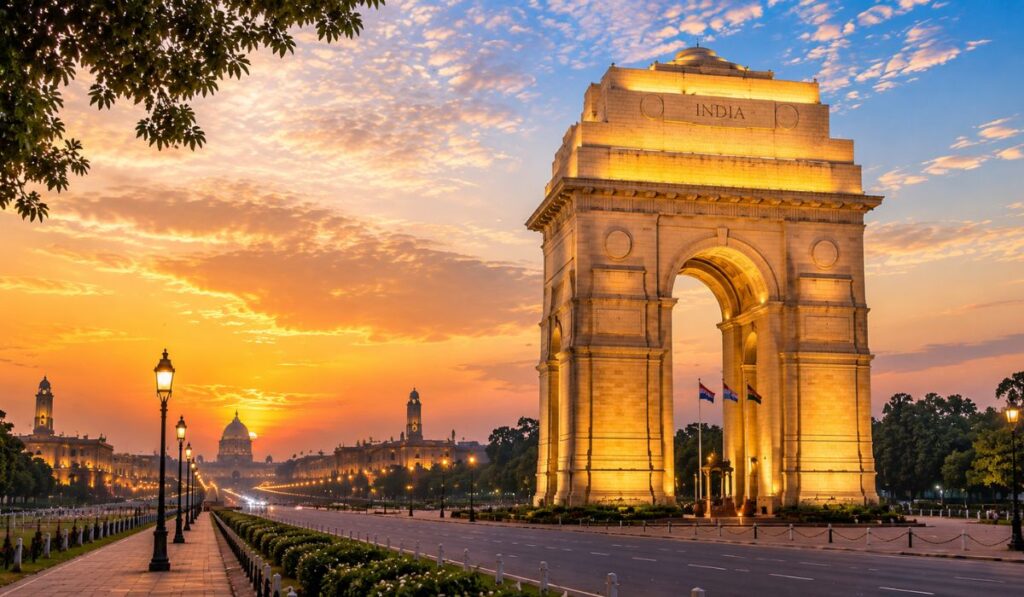
- India Gate — A war memorial and one of Delhi’s most recognizable landmarks. The surrounding lawns are popular with local families, particularly at dusk. The newly opened National War Memorial nearby is equally worth visiting.
- Qutub Minar — A 73-metre medieval minaret dating to 1193, surrounded by the ruins of Delhi’s earliest mosque. The ironwork pillar on the grounds — over 1,600 years old and virtually rust-free — is quietly one of India’s most extraordinary engineering mysteries.
- Humayun’s Tomb — Often described as the architectural forerunner to the Taj Mahal, this 16th-century Mughal garden-tomb is less crowded and arguably more serene. Essential viewing for anyone interested in Mughal architecture.
- Chandni Chowk — The historic bazaar of Old Delhi, dating back to the Mughal period. Overwhelming, noisy, and absolutely worth it. Hire a cycle rickshaw from the Red Fort to navigate the lanes. The food alone — paranthas from Paranthe Wali Gali, jalebi from Old Famous Jalebi Wala, spiced chai from roadside stalls — justifies the sensory overload.
Agra
Every visitor to India eventually ends up in front of the Taj Mahal. The experience of actually seeing it — the scale, the symmetry, the way the marble shifts color with the light — is one of those rare instances where reality lives up to the hype.
Key attractions:
- Taj Mahal — Book tickets in advance at the Archaeological Survey of India website. Arrive at sunrise for the best light and the thinnest crowds. The Sunrise Taj Mahal Tour from Delhi is one of the most popular day-trip options for travelers staying in Delhi who want a single dedicated day here.
- Agra Fort — A 16th-century Mughal fort just 2.5 km from the Taj Mahal. Shah Jahan was put under house arrest here by his own son in his later years, in a tower with a view of the Taj — a detail that adds extraordinary weight to the visit.
- Mehtab Bagh — A garden complex directly across the Yamuna River from the Taj Mahal. The view from here at sunset, with the Taj reflected in the water, is arguably better than the view from inside the Taj complex itself.
- Itimad-ud-Daulah (Baby Taj) — A Mughal mausoleum that predates the Taj Mahal and is often skipped by visitors on tight schedules. It shouldn’t be. The inlaid marble work here is some of the finest in India.
If you’re short on time, the Same Day Taj Mahal Tour by Car from Delhi or the Same Day Taj Mahal Tour by Train are well-structured options. For something unique, the Moonlight Taj Mahal Tour allows you to see the monument under a full moon — one of the most memorable experiences on the entire circuit.
Jaipur
The Pink City is the most visually theatrical of the three. Jaipur rewards slow exploration — there’s enough here to fill three or four days, and the surrounding region adds Rajput palaces, desert landscapes, and some of India’s best handicraft markets.
Key attractions:
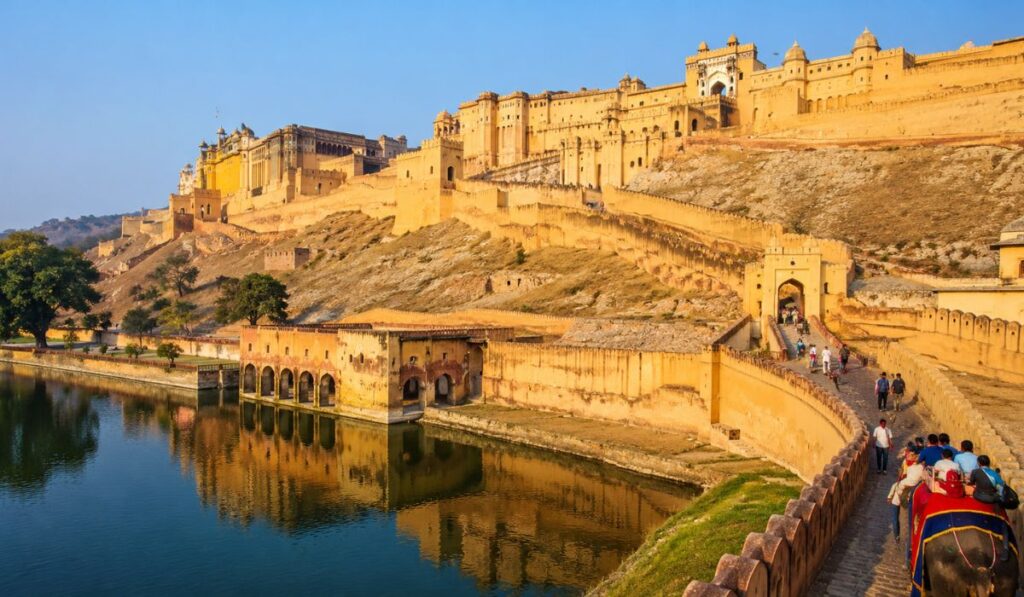
- Amber Fort (Amer Fort) — Perched on a hillside 11 km from the city center, Amber Fort is a Rajput-era palace-fortress built in the 16th century. The sheesh mahal (mirror hall) inside is breathtaking. Go early — by 10 AM the crowds and heat become significant.
- City Palace — A working palace complex (the royal family still occupies part of it) in the heart of the old city. The museum inside has an outstanding collection of royal textiles, weapons, and art.
- Hawa Mahal (Palace of Winds) — The iconic five-story pink sandstone facade with 953 small windows. It was designed to allow the women of the royal household to observe street life without being seen. The interior is smaller than the exterior suggests, but the rooftop views over the old city are excellent.
- Jantar Mantar — A UNESCO-listed astronomical observatory built in 1734. The instruments are enormous stone structures designed to measure time, track celestial bodies, and predict eclipses. Far more interesting than it sounds.
- Jal Mahal (Water Palace) — A palace that appears to float on Man Sagar Lake. You can’t enter (it’s closed to visitors), but the view from the lakeshore, especially at dusk, is one of Jaipur’s most photographed scenes.
Top Attractions Covered in a Golden Triangle Tour
| Attraction | City | Why Visit |
|---|---|---|
| Lutyens’ Delhi incl.India Gate | Delhi | Colonial Architecture |
| Humayun’s Tomb | Delhi | Forerunner to the Taj; less crowded; beautiful gardens |
| Qutub Minar | Delhi | Oldest surviving minaret in India; 13th century ruins complex |
| Chandni Chowk | Delhi | Historic bazaar; best street food in northern India |
| Taj Mahal | Agra | One of the Seven Wonders; sunrise views are unmissable |
| Agra Fort | Agra | UNESCO Heritage; Mughal military and royal architecture |
| Mehtab Bagh | Agra | Sunset views of the Taj Mahal from across the river |
| Itimad-ud-Daulah | Agra | Exquisite marble inlay work; precursor to Taj architecture |
| Amber Fort | Jaipur | Rajput palace-fort; sheesh mahal; elephant rides |
| City Palace | Jaipur | Royal museum; textiles; still partially a working palace |
| Hawa Mahal | Jaipur | Iconic pink facade; old city views from rooftop |
| Jantar Mantar | Jaipur | UNESCO Heritage; 18th-century astronomical instruments |
Slots fill up fast in peak season — secure your verified guide or tour today, one message away on WhatsApp.
💬 Chat on WhatsAppWhat Makes the Golden Triangle Tour So Popular?
Several factors combine to make this the most visited tourism circuit in India:
History and heritage — The route packs in more UNESCO World Heritage Sites per kilometer than almost any comparable journey in the world. Delhi has three UNESCO sites. Agra has two. Jaipur’s old city received UNESCO status in 2019.
Architectural range — In one week you experience Mughal garden-tombs, Rajput hill forts, colonial boulevards, medieval mosques, and 18th-century astronomical observatories. The architectural contrast across just three cities is remarkable.
Food — Northern Indian cuisine is at its most concentrated and varied along this route. From Old Delhi’s street food to Agra’s petha (a sweet made from ash gourd) to Jaipur’s dal baati churma and laal maas.
Shopping — Delhi for silver jewelry and spices, Agra for marble inlay work, Zardozi (Mughal embroidery and leather goods, Jaipur for gemstones, block-printed textiles, blue pottery, and miniature paintings.
Accessibility — Good road connectivity, multiple train options, experienced local guides, and a well-developed tourism infrastructure make the Golden Triangle far easier to navigate than most India itineraries.
Scale — For first-time visitors, the route is large enough to feel like a real India experience but compact enough to be done without becoming exhausted.
Best Time to Visit the Golden Triangle
October to March (Peak Season — Recommended)
This is the ideal window. Temperatures are comfortable across all three cities, ranging from 10°C to 28°C. October and November are particularly good — clear skies, low humidity, and the festivals of Diwali and Pushkar Camel Fair (late October/November in Rajasthan) add cultural texture to the trip. December and January are the coolest months; mornings can be cold (5–8°C in Delhi), but days are pleasant. February and March bring warming temperatures and the Holi festival (late February or March), which is one of India’s most spectacular cultural events.
April to June (Hot Season — Manageable with Planning)
Temperatures climb sharply, reaching 40–45°C in May and June. This is not the most comfortable time to visit, but shoulder-season advantages include lower hotel prices and thinner crowds at major monuments. If you travel in April, it’s still tolerable. The Same Day Jaipur Tour from Delhi is less appealing in peak summer.
July to September (Monsoon Season — Least Recommended)
The monsoon brings heavy rainfall to Delhi and Jaipur (Agra gets less rain). Humidity is high, some roads can flood, and the Taj Mahal is frequently obscured by haze. That said, the landscape turns green, prices drop significantly, and the crowds thin dramatically. Experienced travelers who can tolerate heat and rain can find this an atmospheric time to visit.
Looking for the perfect season? Read our comprehensive Best Time to Visit the Golden Triangle guide before planning your itinerary.
Month-by-Month Quick Reference
| Month | Avg Temp | Conditions | Recommended? |
|---|---|---|---|
| October | 20–32°C | Dry, pleasant, post-monsoon | ✅ Excellent |
| November | 15–27°C | Clear skies, cool evenings | ✅ Excellent |
| December | 8–22°C | Cold mornings, bright days | ✅ Good |
| January | 7–20°C | Coldest month, fog possible | ✅ Good |
| February | 10–25°C | Warming, clear | ✅ Excellent |
| March | 15–30°C | Warm, Holi festival | ✅ Very Good |
| April | 22–38°C | Hot, manageable | ⚠️ Acceptable |
| May | 28–43°C | Very hot | Less preferred |
| June | 28–44°C | Extreme heat, pre-monsoon | Sub-Optimal |
| July | 27–35°C | Monsoon, heavy rain | Less preferred |
| August | 26–34°C | Heavy rain, humidity | Less preferred |
| September | 25–35°C | Rain easing, still humid | ⚠️ Borderline |
How Many Days Do You Need?
3-Day Golden Triangle Tour
A fast but focused trip covering the essential highlights of all three cities. Expect long days and limited flexibility. Best suited for repeat visitors to India or travelers with severe time constraints. You’ll spend one day in Delhi (Old Delhi and monuments), one day in Agra (Taj Mahal and Agra Fort), and one day in Jaipur (Amber Fort, City Palace, Hawa Mahal). View the Golden Triangle 3-Day Itinerary for a structured plan.
4-Day Golden Triangle Tour
A more comfortable pace with time for a second morning in one city. Ideal for travelers who want to see the Taj Mahal at sunrise and also explore Agra Fort. Suits active travelers and those on a fixed schedule.
5-Day Golden Triangle Tour
The sweet spot for most first-time visitors. Enough time to explore each city properly without feeling rushed, with time for a cooking class, a market walk, or a sunset drink overlooking a Site. Suits couples, families, and those on a first India trip.
6-Day Golden Triangle Tour
Adds a day of flexibility — ideal for travelers who want an early morning at the Taj, an afternoon in Mehtab Bagh, and a full day in Jaipur for Amber Fort in the morning and the old city bazaars in the afternoon.
7-Day Golden Triangle Tour
The most relaxed option, and the one we’d recommend for senior travelers, families with young children, luxury travelers, or anyone who prefers depth over pace. Allows for day trips from Jaipur (Abhaneri stepwell, Sanganer block-printing village) and a meaningful second day in Delhi.
Sample 5-Day Golden Triangle Itinerary
Day 1 — Delhi: Old City and Mughal Monuments Morning: Arrive in Delhi, check in, recover from travel. Early afternoon: Red Fort and Chandni Chowk by cycle rickshaw. Evening: India Gate and a walk through Connaught Place for dinner.
Day 2 — Delhi to Agra Morning: Qutub Minar and Humayun’s Tomb. Late afternoon: Drive to Agra (3–4 hours). Check into hotel with Taj Mahal view if budget allows. Sunset at Mehtab Bagh across the river.
Day 3 — Agra Sunrise: Taj Mahal at opening time (6 AM). Spend 2–3 hours exploring. Late morning: Agra Fort. Afternoon: Itimad-ud-Daulah and local markets (marble inlay workshops). Dinner in Agra.
Day 4 — Agra to Jaipur Morning: Drive to Jaipur (4–5 hours) via Fatehpur Sikri — a deserted Mughal city that’s one of India’s most haunting and underrated sites. Afternoon arrival in Jaipur. Evening stroll around the old city walls.
Day 5 — Jaipur Early morning: Amber Fort (beat the heat and the queues). Mid-morning: City Palace and Jantar Mantar. Afternoon: Hawa Mahal, Johari Bazaar for gems and textiles, block-print fabric shopping. Evening: Rooftop restaurant with fort views before departure or overnight stay.
Golden Triangle Tour Cost Breakdown
Costs vary significantly based on travel style, season, and whether you book independently or through a tour operator.
| Travel Style | Estimated Cost Per Person (5 Days) | What’s Included |
|---|---|---|
| Budget | USD $150–$300 | Hostels/budget hotels, trains, entrance fees, street food |
| Mid-Range | USD $400–$800 | 3-star hotels, private car, guided tours, most meals |
| Luxury | USD $1,200–$3,000+ | Heritage/5-star hotels, private guide, flights, spa |
Key cost factors:
- Private car vs. train: A private car with driver for 5 days costs approximately USD $200–$400 for the vehicle. Trains are cheaper but require more planning.
- Hotel category: Budget guesthouses in Jaipur start from $15/night; heritage hotels and 5-star properties run $200–$600/night.
- Guided vs. independent: A professional guide adds $20–$50 per day per person but significantly improves the depth of each site visit.
- Entry fees: The Taj Mahal charges approximately $15 for foreign nationals. Other major sites are $5–$10. Budget $50–$80 total for monument entry fees.
Transportation Options
Private Car Tour
The most popular choice among international visitors. You get door-to-door convenience, flexibility to stop along the way (Fatehpur Sikri, roadside dhabas, photography stops), and a driver who handles all navigation. No need to queue at train stations or manage luggage between platforms.
Best for: Families, couples, first-timers, luxury travelers, anyone with heavy luggage.
Train Tour
India’s train network is extensive and functional. The Gatimaan Express (Delhi–Agra, 100 minutes) is comfortable and punctual. Trains between Agra and Jaipur are slower. Booking on IRCTC requires advance planning and can be complicated for foreign credit cards — use a booking agent if needed.
Best for: Solo travelers, budget travelers, travelers who want an authentic India rail experience.
Flight Connections
Delhi and Jaipur have major airports with frequent domestic flights. Agra’s Kheria Airport has limited service. Flying reduces travel time but adds airport transfer time, check-in hassle, and cost. Not always worth it for these distances.
Guided Tour Packages
All-inclusive packages include accommodation, private transport, English-speaking and other foreign-language guides at each site, and often breakfast. For first-time visitors to India, this removes the logistical burden entirely. The Golden Triangle Tour with Ranthambore is one popular extension package that adds a wildlife safari to the circuit.
Best Places to Stay
Delhi
Connaught Place / New Delhi area: Central, well-connected to the Metro, close to Rajpath and India Gate. Good range of mid-range and luxury options. Karol Bagh: Budget-friendly neighborhood with good transport links. Aerocity: Ideal if you arrive late or depart early — direct Metro to the airport, modern hotels.
Agra
Taj Ganj area: Walking distance to the Taj Mahal’s south gate. Excellent for budget guesthouses with rooftop Taj views. Fatehabad Road: Better for mid-range and upmarket hotels with more amenities. 10–15 minutes from the Taj by auto-rickshaw/Taxi.
Jaipur
Old City (Pink City area): Atmospheric, walking distance to the main monuments and bazaars. Some beautiful heritage havelis converted to boutique guesthouses. Bani Park: Quiet residential area close to the old city, popular with mid-range travelers. C-Scheme / Sansar Chandra Road: Modern hotels and restaurants, good for business-style or higher-end stays.
Food You Must Try
Delhi
- Paranthas at Paranthe Wali Gali (Old Delhi) — Stuffed flatbreads fried on a tawa, served with pickles and chutneys. Order the mixed plate.
- Chole bhature — Spiced chickpeas with deep-fried bread. Heavy, delicious, a Delhi breakfast institution.
- Butter chicken at its origin — Both Moti Mahal (Daryaganj) and Kuremal Mohan Lal Kulfi claim historical associations with this dish.
- Street-side chai — A ritual. The roadside cutting chai in terracotta cups near Jama Masjid is the real thing.
Agra
- Petha — A translucent sweet made from ash gourd, unique to Agra. The Panchi Petha shop near the Taj Mahal is the most well-known outlet. Varieties include angoori (small round), kesari (saffron), and plain.
- Bedai and jalebi — A classic Agra breakfast combination of crispy fried bread with a sweet and spiced potato filling, eaten with sugar syrup spirals.
- Mughlai cuisine — Biryani, kebabs, and korma influenced by the Mughal court kitchen. Look for restaurants near Sadar Bazaar.
Jaipur
- Dal baati churma — The signature Rajasthani meal: lentil dal, baked wheat balls (baati), and sweet crumbled grain (churma). Heavy and memorable.
- Laal maas — A fiery lamb curry made with Mathania red chillies. Not for the timid, but one of the best things you’ll eat in Rajasthan.
- Ghevar — A honeycomb-like deep-fried sweet soaked in sugar syrup. A Jaipur specialty, especially popular during festivals.
- Lassi from Lassiwala (MI Road) — The famous shop serves one type of lassi in clay cups. Join the queue.
Shopping Guide
Agra Handicrafts
- Marble inlay work (pietra dura) — The artisans of Agra have passed down this craft since the Mughal period. Look for decorative plates, boxes, and table tops with semi-precious stone inlay. Prices range from a few hundred rupees to several lakhs for museum-quality pieces.
- Leather goods — Agra has a strong tradition of leather craftsmanship. Shoes and bags at fair prices in Sadar Bazaar.
- Zardozi — An exquisite Mughal-era embroidery tradition that uses metallic threads, beads and sequins to create richly textured designs on fabric. Renowned for its elegance and craftsmanship, it remains one of India’s most celebrated textile arts.
Jaipur Gems and Textiles
- Gemstones and jewelry— Jaipur is one of the world’s largest gem-cutting and trading centers. Buy from reputable shops and ask for certification.
- Mojaris— (embroidered leather shoes), textiles, and handicrafts.
- Block-print fabric — Jaipur is the center of India’s block-printing tradition. Buy fabric by the meter or ready-made clothing. Sanganer (15 km outside the city) is worth a half-day trip for print workshops.
- Blue pottery — Unique to Jaipur, made with a distinctive turquoise glaze. Available throughout the old city.
Is the Golden Triangle Tour Safe for Tourists?
The Golden Triangle is one of India’s most visited and tourist-friendly circuits. That said, India is India — preparation matters.
Solo Travelers
Generally safe, particularly in the daytime. Use licensed guides, pre-book taxis, and avoid accepting unsolicited help from strangers near major tourist sites (particularly at the Taj Mahal gate area, where touts and scammers operate).
Female Travelers
Solo female travelers visit the Golden Triangle regularly and safely, but awareness is important. Dress modestly (cover shoulders and knees at religious sites), be cautious after dark in unfamiliar areas, if you choose not to hire a private vehicle from the travel agent use app-based taxis (Ola/Uber) rather than hailing auto-rickshaws at night, and trust your instincts.
Families
Excellent family destination. Children are welcomed warmly across India. Keep an eye on children in crowded bazaars, carry bottled water at all times, and have an oral rehydration plan for stomach upsets (which are common for new arrivals).
Senior Travelers
The sites involve significant walking, stairs, and uneven ground. Amber Fort involves a steep climb (elephant rides and jeeps are available, though elephant welfare concerns are worth noting). A private car tour with a patient, experienced driver makes a significant difference. See options in the Agra Overnight Tour from Delhi for comfortable paced itineraries.
Practical safety tips:
- Book accommodation in advance; don’t rely on finding rooms on arrival
- Use app-based taxis (Ola, Uber) in cities rather than negotiating with drivers at the roadside
- Never drink tap water.
- Keep a small amount of cash in local currency (₹100–₹500 notes) for tips and small purchases
- Photograph people only with permission — this goes a long way in building goodwill
- Don’t accept unsolicited help at monument gates, train stations, or airports
Golden Triangle Tour for Different Travelers
Couples
The Golden Triangle is one of India’s most romantic travel itineraries — the Taj Mahal was literally built as a monument to love. Add the Moonlight Taj Mahal Tour for a once-in-a-lifetime evening at the monument under moonlight. Jaipur’s rooftop restaurants overlooking illuminated forts make for memorable dinners.
Families
Delhi’s interactive museums (National Museum, Crafts Museum) and the energy of Chandni Chowk work well with older children. Amber Fort’s elephant pathway and the elephant rides (check ethical operator status) engage younger kids. Jaipur’s puppet shows and block-printing workshops are hands-on and fun.
Luxury Travelers
Heritage hotels in Jaipur (converted Rajput havelis and palaces) offer some of India’s finest hospitality. Private guides at each monument, chef-curated dinners, and rooftop candlelit settings at heritage properties elevate the experience significantly above the standard tourist trail.
Photographers
This is one of the most photogenic routes in the world. Sunrise at the Taj Mahal, the pink-lit streets of Jaipur at dawn, the geometric windows of Hawa Mahal, the elephant processions on the road to Amber Fort — every day offers extraordinary frames. Golden hour in Old Delhi — the lanes around Jama Masjid, the flower market at Mehrauli — is exceptional.
Senior Travelers
A private car tour with a flexible schedule, mid-range to luxury accommodation with elevator access, and a guide who knows which sites involve the most walking makes the Golden Triangle perfectly manageable. The 7-day itinerary is recommended to allow for rest days.
Common Mistakes to Avoid
- Visiting the Taj Mahal on a Friday — The Taj is closed on Fridays. Plan around this.
- Underestimating travel times — Delhi to Agra can take 3–4 hours by road. Agra to Jaipur can take 5 hours or more with traffic or road stops. Don’t schedule back-to-back site visits on travel days.
- Not booking Taj Mahal tickets in advance — Online booking is faster and avoids queues.
- Skipping Mehtab Bagh in Agra — The view of the Taj Mahal from across the river at sunset is one of the trip’s highlights, yet most travelers miss it entirely.
- Not carrying cash — India remains a cash-heavy economy, particularly for street food, autos, and smaller shops. ATMs are available but can be unreliable in busy tourist areas.
- Choosing the cheapest possible tour operator — The difference between a knowledgeable guide arranged through the travel agency and an unauthorized one found outside a monument one is enormous. Budget heavily on accommodation and guiding before cutting costs elsewhere.
Essential Travel Tips for First-Time Visitors to India
Currency: The Indian Rupee (₹). Exchange money at airports, banks, or licensed money changers. Don’t use unofficial street exchange. ATMs are available but have daily withdrawal limits (usually ₹10,000–₹20,000). Inform your bank before departure.
SIM Cards: Buy a prepaid Indian SIM at the airport (Airtel and Jio are the most reliable networks). You’ll need your passport and a passport photo. Costs around ₹300–₹500 for a month of data and calls.
Local Etiquette: Remove shoes before entering temples, mosques, and gurudwaras. Dress conservatively at religious sites (cover shoulders and knees). Ask permission before photographing people. Eating beef is taboo in Hindu areas; avoid pork in Muslim neighborhoods.
Transportation: Use Ola or Uber for city rides — metered and transparent. Auto-rickshaws require negotiation; agree on the fare before getting in. Never accept rides from drivers who approach you unsolicited at tourist sites.
Tipping: Not mandatory but appreciated. especially for guides, drivers and hospitality staff who provide good service.
Clothing: Lightweight, loose, breathable clothing is practical year-round. A light scarf is useful for women at religious sites, on dusty roads, and against air conditioning on trains. Comfortable walking shoes with good grip matter at fort sites.
Stomach health: Stick to cooked food, avoid unpeeled fruit, and never drink tap water. Imodium and oral rehydration salts are worth carrying. A mild stomach upset is common in the first couple of days and usually resolves quickly.
Best Golden Triangle Tour Extensions
The Golden Triangle is a starting point, not a ceiling. The following extensions are the most popular — and most rewarding — ways to deepen your India experience.
Golden Triangle with Ranthambore
Add 2–3 days at Ranthambore National Park, 160 km from Jaipur, for the best chance of spotting Royal Bengal tigers in their natural habitat. The combination of Taj Mahal and tiger safari is uniquely compelling and doesn’t require doubling the length of the trip. The Golden Triangle with Ranthambore Tour is one of the most booked extensions on the circuit.
Golden Triangle with Udaipur
The City of Lakes adds Rajput palace architecture, lake views, and a noticeably slower, more romantic atmosphere. Udaipur is connected to Jaipur by road (4–5 hours) or a short flight. Best for couples and travelers extending into Rajasthan.
Golden Triangle with Varanasi
Varanasi is a completely different India — ancient, spiritual, overwhelming. A 2-day extension by flight from Delhi gives you the Ganga Aarti ceremony, dawn boat rides on the Ganges, and an encounter with the oldest living city in the world. Golden Triangle with Varanasi is ideal for travelers seeking depth beyond palaces and forts.
Golden Triangle with Amritsar
Adding the Punjab capital to your trip via Delhi (by train or flight, 5–6 hours) brings you to the Golden Temple — one of the most serene and spiritually moving places in Asia. The Wagah Border ceremony at sunset, where Indian and Pakistani border guards perform an elaborate flag-lowering ritual, is unlike anything else in India. The Golden Triangle with Amritsar extension works especially well if you’re flying in or out of Delhi.
Golden Triangle with Jodhpur
The Blue City adds another layer of Rajput history, the magnificent Mehrangarh Fort, and a distinctly different color palette — all those blue-washed buildings clustered below a hilltop fortress. Suits travelers who want a fuller Rajasthan experience.
Golden Triangle with Goa
An unusual combination but a logical one for international visitors wanting contrast. Fly from Delhi or Jaipur to Goa for 3–4 days of beaches, colonial Portuguese architecture, and seafood after the intensity of the north. Suits couples and travelers on longer trips.
Golden Triangle Tour vs Rajasthan Tour
| Feature | Golden Triangle | Rajasthan Tour |
|---|---|---|
| Cities covered | Delhi, Agra, Jaipur | Jaipur, Jodhpur, Udaipur, Jaisalmer, Pushkar, more |
| Duration | 3–7 days | 7–15 days |
| Focus | Mughal + Rajput heritage, Taj Mahal | Rajput palaces, desert, royal culture |
| Best for | First-time India visitors | Travelers returning to India or with more time |
| UNESCO Sites | 5+ | Multiple |
| Desert experience | No | Yes (Jaisalmer sand dunes) |
| Wildlife | Only with Ranthambore extension | Ranthambore, Kumbhalgarh Wildlife Sanctuary |
| Pace | Manageable in under a week | Requires at least 10 days to do it justice |
| Effort | Moderate | High — significant distances |
Golden Triangle Tour vs South India Tour
| Feature | Golden Triangle | South India Tour |
|---|---|---|
| Architecture | Mughal, Rajput, | Dravidian temples, colonial, Kerala backwaters |
| Landscape | Flat plains, arid Rajasthan | Coastal, tropical, hills (Western Ghats) |
| Food | North Indian, Mughlai, Rajasthani | Tamil, Kerala, Chettinad, seafood |
| Climate | Hot summers, cool winters | Tropical year-round, distinct monsoon |
| Duration needed | 3–7 days | 7–14 days |
| Best for | First-time India visitors, history focus | Repeat visitors, nature lovers, foodie travelers |
| Iconic experience | Taj Mahal, Amber Fort | Kerala backwaters, Meenakshi Temple, Hampi |
Is the Golden Triangle Tour Worth It?
Honestly? Yes — with the right expectations.
The Golden Triangle is not a hidden gem. Millions of people visit every year, and you will feel that at the Taj Mahal on a busy weekend morning. Some of the roads between cities are long and tiring. The heat in April and May is brutal.
But here’s what’s also true: the Taj Mahal really is as spectacular as everyone says. Amber Fort genuinely takes your breath away. Chandni Chowk at dusk is unlike anywhere else on earth. Old Delhi’s lanes are is extraordinary in ways a photograph can’t capture.
For first-time visitors to India, the Golden Triangle provides the right balance of manageability and authenticity. It’s not a sanitized, resort-style tour. It’s India — overwhelming, beautiful, frustrating, and unforgettable — in a format that won’t break you on your first visit.
If you’ve never been to India, start here. Add extensions later if the country gets under your skin (and it usually does).
Frequently Asked Questions
What is the Golden Triangle Tour in India?
The Golden Triangle Tour is a travel circuit connecting Delhi, Agra, and Jaipur — three cities in northern India that form a triangular shape on the map. It covers some of India’s most iconic monuments including the Taj Mahal, Agra Fort, Red Fort, Amber Fort, and Hawa Mahal. The route spans approximately 720 km and can be completed in 3 to 7 days, making it the most popular introduction to India for international visitors.
Which cities are included in the Golden Triangle?
The Golden Triangle consists of three cities: Delhi (India’s capital), Agra (home of the Taj Mahal), and Jaipur (capital of Rajasthan, known as the Pink City). Some extended versions of the tour add cities like Ranthambore, Varanasi, Udaipur, or Amritsar to the core itinerary.
How many days are enough for the Golden Triangle?
Five days is the most comfortable option for a first-time visitor, giving you a full day in each city with reasonable travel time between them. Three days is the minimum if your schedule is tight, while seven days allows for a relaxed pace with room for day trips and spontaneous exploration. Families and senior travelers benefit from at least six days.
What is the best month to visit the Golden Triangle?
October through March is the best time to visit. October, November, February, and March offer the most pleasant weather — comfortable temperatures, minimal rain, and clear skies. December and January are cooler (sometimes foggy in Delhi & Agra) but still excellent. May and June, are less preferred when temperatures can reach 44°C.
Is the Golden Triangle Tour safe for foreigners?
Yes. The Golden Triangle is one of India’s most tourist-developed circuits with established infrastructure, experienced guides, and well-practiced local tourism economies. Use safe and reliable vehicles for transportation, book accommodation in advance, be cautious near major monuments where touts operate, and drink only sealed bottled water. Female solo travelers visit regularly — dress modestly and use trusted transport options.
Can I travel the Golden Triangle independently?
Yes, it’s entirely possible to travel independently using trains, buses, and local transport. However, for first-time visitors, the combination of language barriers, infrastructure complexity, and the logistical effort of booking across multiple cities makes a guided package or at minimum a private car with driver significantly more efficient. Independent travel suits experienced India travelers or those on a strict budget.
How much does the Golden Triangle Tour cost?
Budget travelers can do the 5-day circuit for $150–$300 per person (hostels, trains, street food). Mid-range travelers spending on 3-star hotels, a private car, and guided entry should budget $400–$800 per person. Luxury travelers using heritage hotels, private drivers, and upscale dining can spend $1,500–$3,000+ per person. Entry fees for all major monuments add approximately $50–$80 per person.
Is the Golden Triangle Tour suitable for families?
Absolutely. The three cities offer engaging experiences for children of most ages — Amber Fort’s elephant pathway, Old Delhi’s cycle rickshaw rides, Jaipur’s puppetry and block-printing workshops, and the sheer spectacle of the Taj Mahal all work well with younger travelers. A private car tour with a flexible schedule is the most practical family option. Carry oral rehydration salts, sunscreen, and more snacks than you think you need.
Can I add Ranthambore to the Golden Triangle Tour?
Yes, and it’s highly recommended. Ranthambore National Park is approximately 160 km from Jaipur, adding 2 days and giving you a genuine chance of spotting Royal Bengal tigers. It’s the most popular and logical extension to the core circuit. The Golden Triangle with Ranthambore Tour handles this combination seamlessly.
Is the Golden Triangle Tour worth visiting?
Yes, for most first-time visitors to India, it’s the single most rewarding introduction to the country available. The Taj Mahal, Agra Fort, Red Fort, Amber Fort, and the cities of Delhi and Jaipur represent an extraordinary concentration of historical and cultural heritage. The route is manageable, the infrastructure is developed for international travelers, and the experiences on offer are genuinely world-class. The Golden Triangle isn’t perfect — India rarely is — but it’s memorable in all the right ways.
Conclusion
The Golden Triangle Tour is the most logical starting point for anyone visiting India for the first time. In a country this vast and complex, the circuit offers something rare: a structured, manageable route that doesn’t sacrifice authenticity.
You’ll stand in front of the Taj Mahal and understand why it’s considered one of humanity’s greatest architectural achievements. You’ll walk through centuries of layered history in Delhi’s lanes and monuments. You’ll watch the sun rise over a Rajput hill fort in Jaipur and wonder why you waited so long to come.
The Golden Triangle doesn’t show you all of India — that’s impossible in any timeframe. What it does is give you a foothold: three cities, six or seven days, and enough experiences to understand why this country has fascinated travelers for centuries.
If you want a trip that’s well-organized, richly historical, and genuinely immersive from the first day, explore our Golden Triangle Tour packages for flexible itineraries from 3 to 7 days, with private cars, expert guides, and handpicked accommodation across Delhi, Agra, and Jaipur.